
AI-Powered Biodiversity Monitoring for Renewable Energy Sites
Project Lead Institution: UC Wild Solar, Drs. Hernandez and Steele
ScienceDocs Contributor: Dr. Kursun
Project Summary
In this collaboration, we developed an AI-assisted pipeline to monitor waterbird activity near renewable energy infrastructure using camera imagery. Using a pretrained YOLO model, the system automatically detects birds from large-scale image datasets. These detections are then cropped and passed into a semi-supervised deep learning framework that uses both visual similarity and spatial context (e.g., birds appearing in the same scene) to group and classify species. This scalable system enables researchers to track peak bird abundance and species diversity. Such activity trends across time with minimal need for extensive manual data labeling supports environmental impact assessments for floating solar farms and other renewable installations.
Figure 1.
An exemplary plot showing the number of detected birds over a period of time. Bars represent hourly counts, while the smoothed curve highlights temporal trends. A dashed red line marks the weekly peak activity level for comparison. Thus, such plots can help select specific image files for annotation using tools like CVAT, focusing labeling efforts on frames that are most informative for downstream machine learning models.
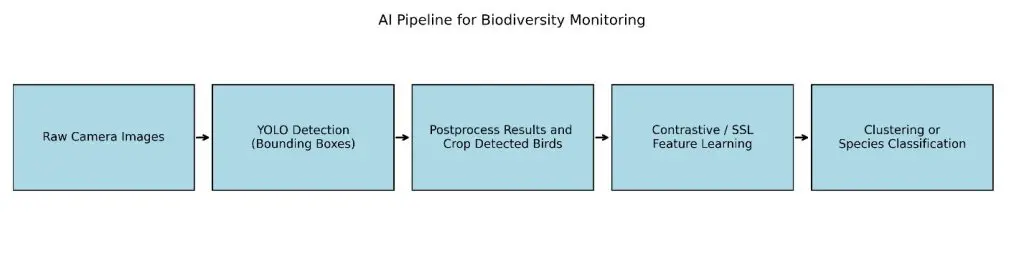
Figure 2.
Overview of the AI pipeline for bird detection and classification. The process begins with raw camera images, followed by bird detection using a pretrained YOLO model. Detected regions are cropped and passed through a semi-supervised ML stage to be classified and then counted.
Figure 3.
Two exemplary image pairs are shown. In each case, the left panel displays the raw input image, while the right panel shows the corresponding YOLO-based bird detections. Red boxes indicate false positives that were eliminated through postprocessing.


Note a related SWERM poster that ScienceDocs was involved in, delivered by Dr. Elliott Steele in Dec 2025.